
Since the use of IFRS is on the rise around the world, knowing about IFRS provides an edge to any individual in the field of finance. The IFRS course gives insight into accounting rules and practices in a variety of countries, which include financial report preparation, accounting frameworks, and reporting standards used by multinational companies. This skillset is essential for professionals to comprehend financial information when dealing with global operations.
Knowing about IFRS is crucial to professionals pursuing careers in areas like audit, investment banking, and finance because professionals in the fields of audit and finance make use of IFRS full form – International Financial Reporting Standards, while assessing the veracity of the financial statement and for making investments. Similarly, tax professionals benefit from determining the implications of financial reporting for tax laws.
How IFRS Course Helps Building Career in Investment Banking, Audit & Related Sectors?
1. Enhances Financial Statement Analysis and Audit Accuracy
Understanding IFRS enables auditors to determine which principles and standards have been applied in the preparation of financial statements. As part of their job, audit professionals must be able to determine whether accounting standards have been followed and whether there are any reporting errors. With a proper understanding of the IFRS course, an auditor can do that more effectively.
With globalisation taking place in every business today, there are a lot of multinational companies that prepare financial statements. With knowledge about IFRS, audit professionals will be in a better position to deal with accounting treatment of various issues such as income recognition, financial instruments, leasing and valuation of assets.
2. Supports Tax Planning and Regulatory Compliance
Since the tax rules are provided by local laws, the full form of IFRS full form – International Financial Reporting Standards affects the accounting process. The professionals who have expertise in IFRS can easily differentiate accounting profit and taxable profits, which assists organisations in meeting their tax requirements. It is essential because it will be helpful in preparing deferred taxes and for recognising tax assets or liabilities.
Moreover, as the government has decided to coordinate tax rules with international accounting standards, IFRS course professionals are capable of assisting organizations in dealing with various compliance requirements. They can use their financial skills based on IFRS in tax planning to avoid mistakes in reporting or face any penalty.
3. Improves Valuation and Financial Modelling in Investment Banking
For accurate assessment of companies in terms of their valuation, mergers & acquisitions, investment decisions, and raising funds, it is crucial for investment bankers to have sound knowledge about IFRS full form – International Financial Reporting Standards. It assists them in interpreting the company’s financial statements to prepare a robust valuation model. It is especially crucial while evaluating companies operating in international business environments.
An understanding of the importance of IFRS enables investment banking professionals to assess the impact of different accounting policies on income, liabilities, assets, and cash flows. With an analysis of the changes needed to make proper comparisons between companies, it becomes easy for professionals to develop precise financial models for investment.
4. Facilitates Cross-Border Transactions and Global Business Operations
Many firms participating in international trade, acquisitions, and investments employ IFRS as their accounting framework. Individuals working in tax, audit, and investment banking often deal with businesses operating in multiple countries. An understanding of IFRS accounting helps one ascertain and compare financial reports prepared under a single international framework, making international transactions easier.
An understanding of IFRS helps an individual involved in mergers, acquisitions, and due diligence work as he/she would be dealing with financial reports from many countries. For auditors and tax consultants, this understanding helps them provide a uniform level of advice to firms with international operations.
5. Strengthens Strategic Decision-Making and Career Growth
The knowledge gained from the IFRS course is not limited to accounting; it also serves as a guide for making well-informed decisions about business operations. Professionals in tax, auditing, and investment banking utilise financial information to advise management, stakeholders, and investors on business matters. The determination of the IFRS will help them assess the firm’s financial performance effectively, recognise the risks involved, and provide guidance for business growth.
In terms of career development, knowledge of IFRS is highly regarded by international companies, accounting firms, consulting firms, and investment banks. Employers need professionals who are competent in applying international accounting standards and can help their firms undertake international financial reporting activities. With globalisation becoming rampant, having an IFRS qualification gives an individual a competitive advantage.
Final Takeaway
Knowledge of IFRS is an important attribute for professionals in taxation, auditing, and investment banking, as it helps them analyse financial statements effectively. This will not only ensure regulatory compliance but also support decision-making within their business. Since businesses operate globally and apply global standards in their reporting, taking an IFRS course can help professionals boost their analysis skills and report more accurately.
Are you ready to build an internationally relevant finance career? Connect with Zell Education experts and gain industry-focused IFRS training that prepares you for the opportunities across tax, audit, investment banking and other high-growth finance areas worldwide.
FAQs
1. How does IFRS benefit investment banking professionals?
IFRS knowledge helps professionals focus more on financial analysis and due diligence.
2. Why is IFRS knowledge important in taxation?
IFRS assists tax professionals in determining the impact of financial planning on tax planning and overall compliance.
3. Is IFRS knowledge useful for financial statement analysis?
Yes, it enhances the ability to interpret and compare the financial reports across the organisations.
____________________________________________________________________________
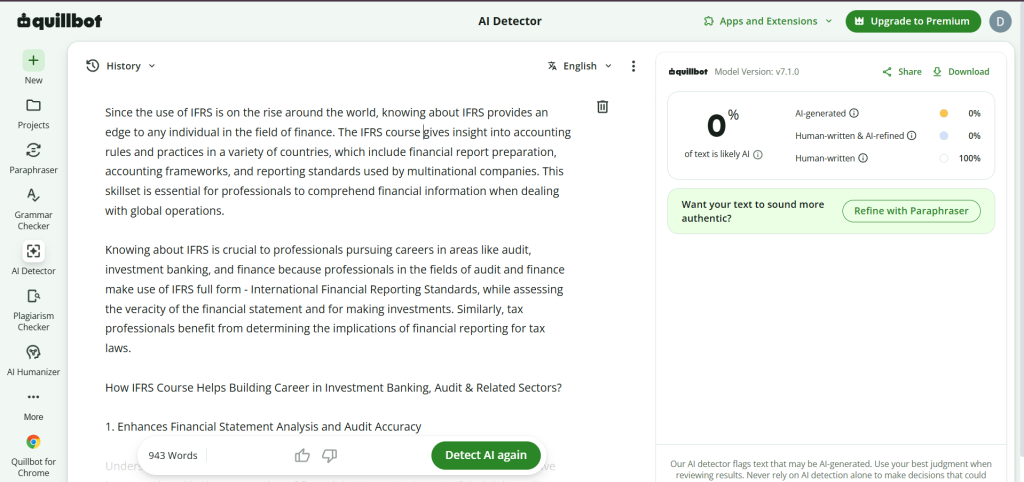
Quillbot Report
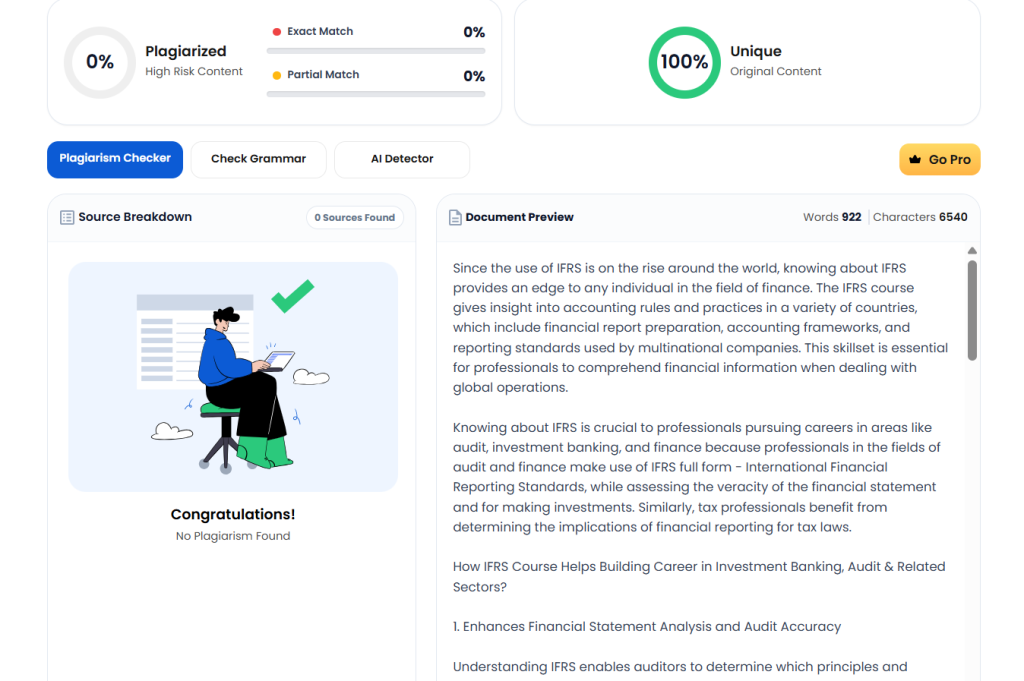
Plagiarism Report