

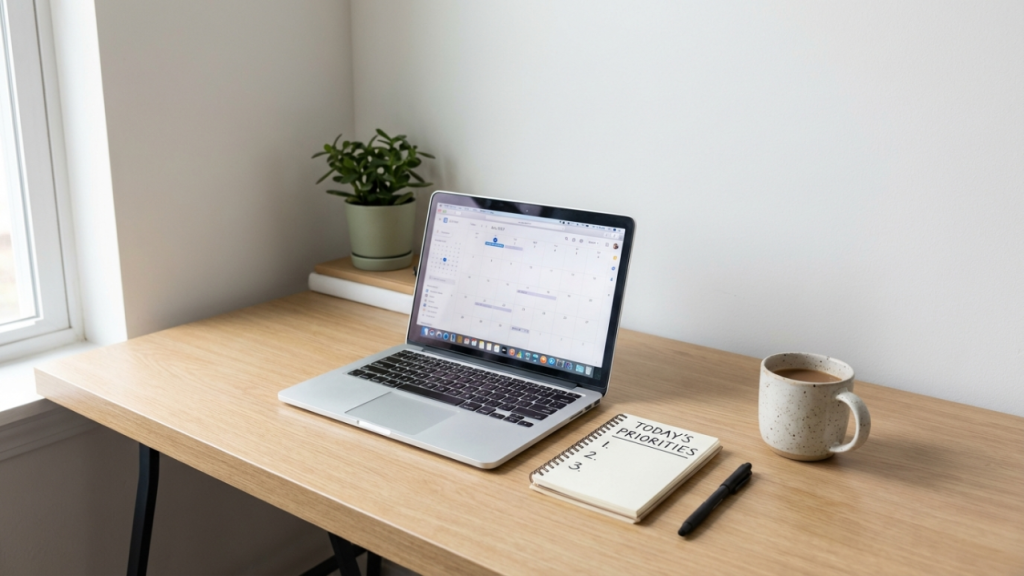
Working from home sounds straightforward on paper. No commute, no crowded office, no noise from the next cubicle. But anyone who has done it for more than a week knows the reality is more complicated. The same space where you relax, eat, and sleep is now also where you are expected to focus, meet deadlines, and stay professional. Without the right habits in place, hours disappear and the to-do list barely moves. The good news is that the habits that make remote work function well are learnable, and none of them require expensive tools or complicated systems.
Why Working From Home Is Harder Than It Looks
The office, for all its frustrations, provides structure by default. Your commute signals the start of the workday. The presence of coworkers creates a kind of social accountability. Meetings happen at fixed times. When you remove all of that and place yourself at home, you are responsible for recreating that structure entirely on your own.
Without structure, the boundaries between work time and personal time blur quickly. You might start checking emails before breakfast, then find yourself watching videos in the middle of the afternoon, then feel guilty and work into the evening. None of those hours are particularly productive, and the pattern leaves you feeling exhausted without the satisfaction of having finished anything well. Recognizing this is the first step toward fixing it.
Create a Workspace That Your Brain Can Recognize
One of the most effective things you can do is give your brain a clear signal for when it is time to work. That signal usually comes from a dedicated physical space. It does not need to be an entire room. A specific corner of a room, a particular chair at the dining table, or even just a cleared desk surface can work, as long as you use it consistently for work and nothing else.
The key is consistency. When you always sit at the same spot to work and never use that spot to scroll social media or watch videos during breaks, your brain starts to associate it with focus. Over time, simply sitting down in that spot begins to shift your mindset toward work without much effort on your part. This is not a complicated psychological trick. It is just how habits form when you repeat the same context enough times.
Build a Daily Schedule and Protect It
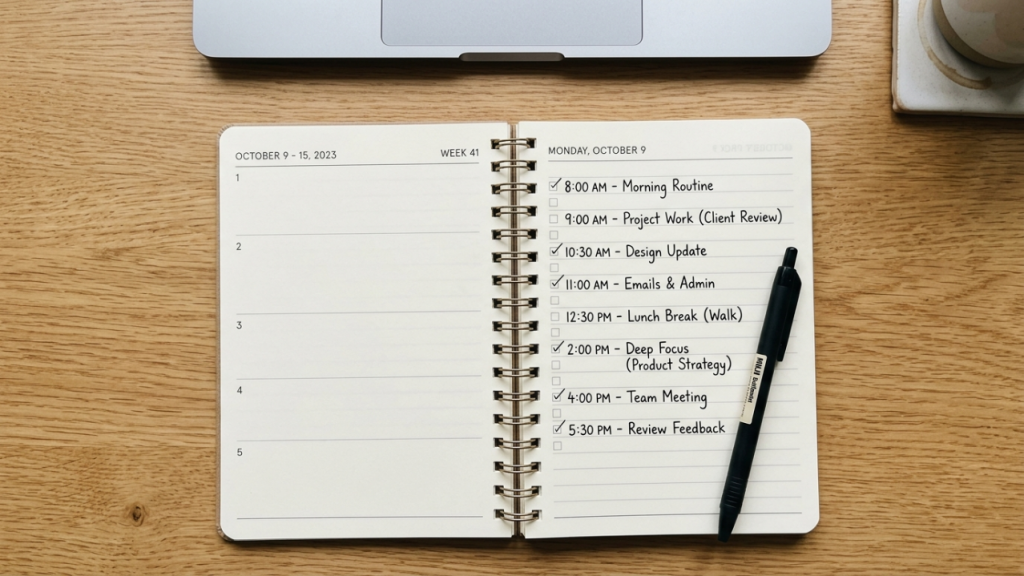
The most productive remote workers treat their schedule the same way an office environment treats it — as a fixed structure that exists whether or not they feel like following it. That means setting a consistent start time, blocking time for focused work, and scheduling breaks rather than leaving them to chance.
One approach that works well is time-blocking — assigning specific tasks to specific blocks of time in your calendar. Rather than starting the day with a vague list, you decide in advance that from nine to eleven you will work on a specific project, from eleven to eleven-thirty you will handle emails, and so on. This removes the mental overhead of constantly deciding what to do next, which quietly drains more energy than most people realize.
Breaks are not optional. Research consistently shows that working in focused blocks with short breaks in between leads to better output than grinding through long uninterrupted sessions. The brain needs time to process and reset. Even a ten-minute break to step away from the screen makes the next work block more effective. People who manage high-output schedules in demanding environments — including those in fast-moving online industries like PH365 — understand that sustainable performance requires recovery built into the day, not just effort. PH365 communities often point out that structured time management applies equally whether you are running a business, managing a team, or working solo from home.
Handle Distractions Before They Handle You
Distractions at home come in two forms: the ones you can control and the ones you cannot. The ones you can control include your phone, social media, streaming services, and the general pull of household tasks. The ones you cannot fully control include family members, deliveries, and unexpected noise from outside.
For the controllable distractions, the solution is usually to make them harder to access during work hours rather than relying on willpower alone. Put your phone in another room or use a focus mode that silences non-essential notifications. Log out of social media platforms on your browser so that opening them requires an extra step. Use website blockers during focused work blocks if you find yourself drifting to certain sites habitually. These small friction points are surprisingly effective because most distraction is not deliberate — it is automatic.
For distractions you cannot fully control, communication works better than hoping people notice you are busy. Setting clear expectations with others in the household — a closed door, headphones on, or a shared calendar note — prevents more interruptions than any technical tool.
Set a Real End Time for Your Workday
One of the counterintuitive challenges of working from home is working too much rather than too little. Because the office is always there and the laptop is always nearby, it is easy to keep going well past a reasonable stopping point. This creep into personal time feels productive in the short term but leads to burnout and diminishing returns over weeks and months.
Decide on a time when work ends and stick to it the same way you would if you had to physically leave an office. When the workday is over, close your work tabs, put your laptop away if possible, and do something that signals the transition to personal time. This might sound rigid, but it is one of the most important boundaries a remote worker can maintain. Communities built around high-engagement lifestyles, such as those connected to platforms like Okebet 168, often note that knowing when to switch off is as valuable as knowing how to focus. Okebet 168 users and similar communities emphasize that rest and recovery are part of any high-performance routine, not a reward you earn only after exhaustion.
Use Simple Tools Without Overcomplicating the System
There is no shortage of productivity apps, task managers, and time-tracking tools available. Some of them are genuinely useful. Most remote workers, however, do not need a complicated system. They need a short list of priorities for the day, a reliable calendar, and a timer.
Write down the three most important things you need to finish before the end of each workday. Not ten things, not everything on the running list — just three. This practice forces you to think clearly about what actually matters and prevents the feeling of being busy all day without completing anything significant. A physical notebook works just as well as any app for this purpose, and for many people it works better because it does not sit next to every other digital distraction.
A simple timer set to 25 or 45 minute intervals helps sustain focus during deep work sessions. Knowing a break is coming at a fixed point makes it easier to resist checking your phone mid-task. Over a full workday, these focused intervals add up to a meaningful amount of quality output.
Protect Your Energy, Not Just Your Time
Time management gets most of the attention in productivity advice, but energy management matters just as much. You can have a perfectly structured schedule and still produce poor work if you are running on poor sleep, skipping meals, or sitting in the same position for eight hours without moving.
Remote work makes it easy to neglect physical basics because no one is around to notice. Building movement, meals, and daylight into your routine directly affects the quality of the work you produce. A twenty-minute walk at lunch consistently improves your focus and mood for the rest of the afternoon more than another twenty minutes of screen time.
Getting productive at home is less about finding the perfect system and more about making deliberate choices about your environment, your schedule, and your habits. Most of the changes that make the biggest difference cost nothing and take very little time to implement. Start with a consistent workspace, a fixed schedule, and a short daily priorities list. Build from there as you learn what works for your particular situation. Whether you came across this through a news feed, a colleague’s recommendation, or a community platform like PH365 or Okebet 168, the core advice remains the same: structure your day before the day structures you, and protect your time with the same seriousness you would give to a commitment made to someone else.