

Introduction
Market basket analysis often begins with a simple question: which products tend to appear together in the same transaction? Algorithms like Apriori answer this by finding frequent itemsets and then generating association rules. However, Apriori can struggle when the number of distinct items is large. Even if only a small fraction of item pairs are truly frequent, Apriori may still generate and count a huge number of candidate pairs, consuming memory and time. The PCY (Park–Chen–Yu) algorithm is a classic improvement that reduces candidate pair explosion by using hashing and a compact bitmap. It is a practical topic for anyone learning large-scale pattern mining in a data science course in bangalore or strengthening data mining foundations through a data scientist course.
Why Apriori Becomes Expensive for Pairs
Apriori works level-wise: it first finds frequent single items, then generates candidate pairs from those items, and counts pair supports by scanning the dataset. The problem is the number of candidate pairs can be enormous. If there are (m) frequent items, the number of potential pairs is (m(m-1)/2).
For example, if 10,000 items survive the first pass as “frequent,” the number of possible pairs is close to 50 million. Most of these pairs will never meet the minimum support threshold, but Apriori still has to consider them. Storing counts for so many candidates can exceed memory limits and slow down the counting pass. PCY addresses this bottleneck by eliminating many impossible pairs before counting them explicitly.
The Core Idea: Hashing Pair Counts into Buckets
PCY keeps Apriori’s first pass idea—count individual items—but adds one more activity during that same pass: it hashes item pairs into a limited number of buckets and counts how many times each bucket was hit.
What happens in Pass 1
During the first scan of the dataset:
- Count item supports to determine frequent single items.
- Hash every pair of items in each basket into a bucket using a hash function.
- Increment the bucket count each time a pair maps to that bucket.
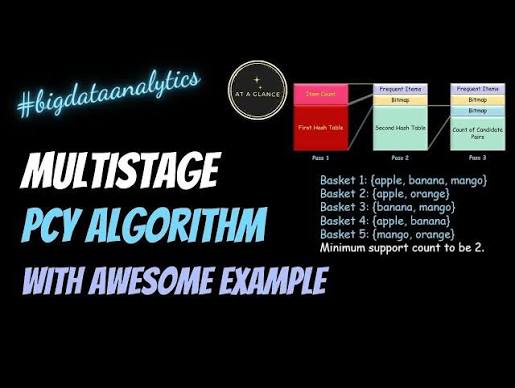
At the end of the pass, PCY converts bucket counts into a bitmap (or a list of “frequent buckets”). A bucket is marked as frequent if its count is at least the minimum support threshold. This step is important: a frequent bucket does not guarantee every pair in it is frequent, but an infrequent bucket guarantees that no pair mapped to it can be frequent.
This bucket filter is where hashing adds power. You keep only bucket-level counts, not counts of every individual pair, so memory usage is far smaller than storing tens of millions of pair counters.
Pass 2: Candidate Generation with Two Filters
In the second pass, PCY generates candidates more carefully than Apriori. Instead of considering all pairs of frequent items, it applies two filters:
- Frequent-item filter: both items must be frequent singles.
- Frequent-bucket filter: the bucket produced by hashing the pair must be marked frequent in the bitmap.
Only pairs that pass both conditions are treated as candidates and counted explicitly in Pass 2. This can cut candidate pairs drastically, especially when baskets are large and the item universe is wide.
A simple way to think about it: Apriori asks, “Are both items frequent?” PCY asks, “Are both items frequent, and does the hash bucket suggest the pair could plausibly be frequent?” That extra check often removes the majority of pairs early.
This is the kind of optimisation that shows up when learners move beyond basic algorithms in a data scientist course, because it demonstrates how to trade a small amount of approximation (bucket counting) for major improvements in compute and memory.
Example Intuition: How Hashing Reduces Work
Imagine you have 5,000 frequent items after Pass 1. Apriori might consider about 12.5 million pairs. With PCY, many of those pairs will hash into buckets whose counts are far below the support threshold. Those buckets become “0” in the bitmap, and every pair mapping to them is discarded without ever being counted individually.
Even if the hash function creates collisions (different pairs mapping to the same bucket), the bitmap still provides a safe pruning rule:
- If a bucket is infrequent, every pair in it is definitely infrequent.
- If a bucket is frequent, the pairs in it are “possible” candidates, but still need exact counting.
This ensures the algorithm does not miss truly frequent pairs due to hashing. Collisions may allow some infrequent pairs to survive the filter, but they will be removed during exact counting in Pass 2.
Strengths, Trade-Offs, and Practical Considerations
Strengths
- Major reduction in candidate pairs: especially effective when item counts are high and true frequent pairs are relatively rare.
- Lower memory footprint: storing bucket counts and a bitmap is far cheaper than storing counts for every possible pair.
- Same number of passes as Apriori for pairs: still typically two passes to find frequent pairs, but with far less work in Pass 2.
Trade-offs
- Hash collisions reduce pruning power: collisions can cause some extra candidates to survive, but they do not cause false negatives for frequent pairs.
- Choice of bucket size matters: too few buckets increases collisions; too many buckets may not fit in memory.
- Mainly targets the 2-itemset bottleneck: extensions exist for larger itemsets, but PCY’s biggest win is usually at the pair level.
In real systems, you would tune the number of buckets based on memory constraints and dataset size. Discussions like these are common in a data science course in bangalore because they connect algorithm design to infrastructure realities.
Conclusion
The PCY (Park–Chen–Yu) algorithm improves frequent itemset mining by reducing the number of candidate pairs that must be counted explicitly. It does this by hashing pairs into buckets during the first pass, building a bitmap of frequent buckets, and using that bitmap as a fast filter in the second pass. The result is a more scalable approach than basic Apriori when datasets contain many items and potential pairs. Understanding PCY helps you see how hashing, compact data structures, and safe pruning rules can make classic data mining tasks feasible at scale—skills that fit naturally into both a data scientist course and a data science course in bangalore.
For more details visit us:
Name: ExcelR – Data Science, Generative AI, Artificial Intelligence Course in Bangalore
Address: Unit No. T-2 4th Floor, Raja Ikon Sy, No.89/1 Munnekolala, Village, Marathahalli – Sarjapur Outer Ring Rd, above Yes Bank, Marathahalli, Bengaluru, Karnataka 560037
Phone: 87929 28623
Email: [email protected]
