

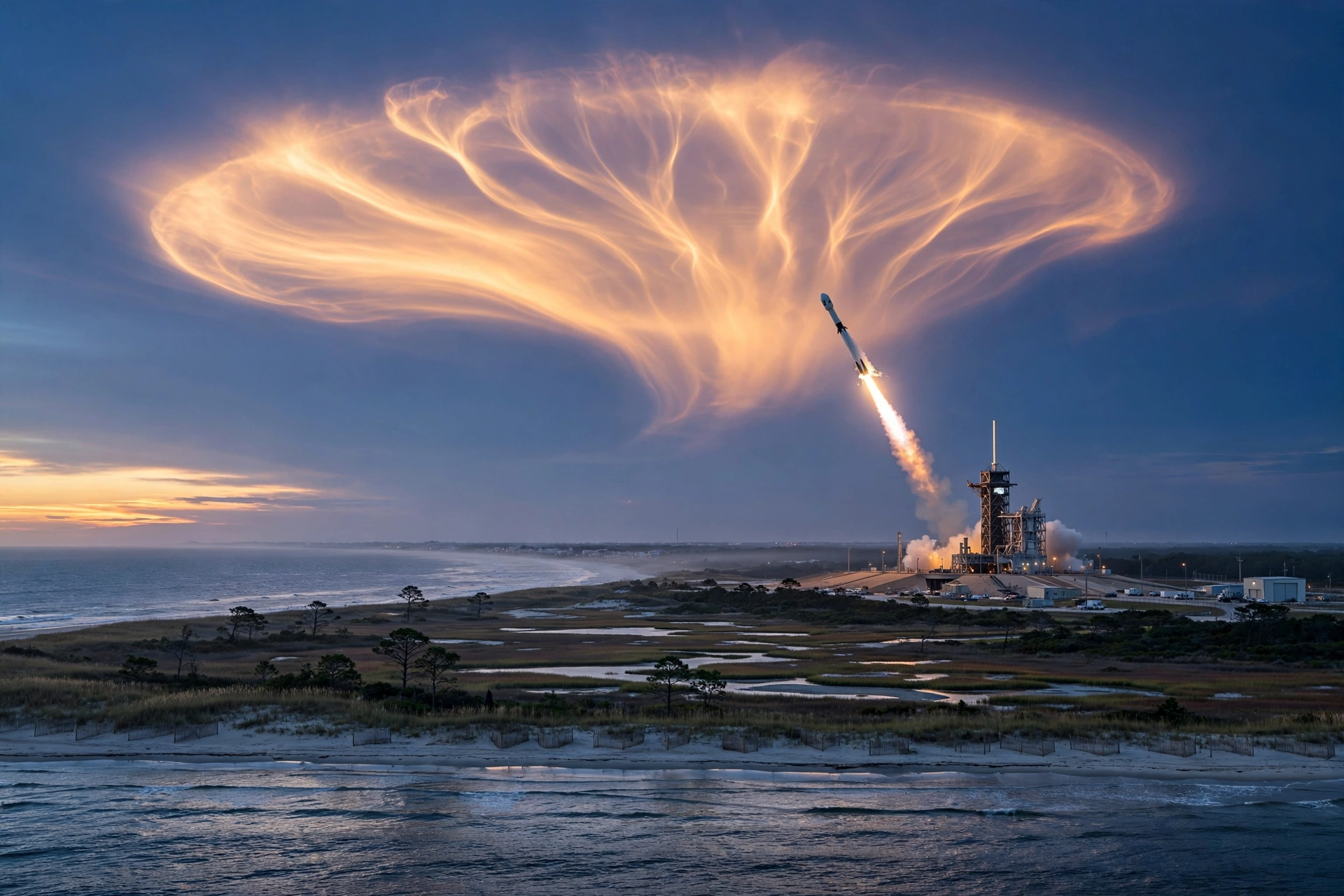
A Dawn Spectacle in the Sky
Early risers along the US east coast were treated to an unusual sight this week when a SpaceX rocket launch created a stunning ‘jellyfish cloud’ in the twilight sky. As the rocket climbed high above the Atlantic, its expanding exhaust plume caught the first light of the sun while the ground below was still in relative darkness. The result was a luminous, tentacled shape that seemed to hover and slowly unfurl, prompting a wave of photographs and videos from stunned onlookers in several states.
Reports described by The Guardian captured the sense of wonder that followed the launch. Many witnesses initially had no idea what they were looking at. Within minutes, social media filled with images of a bright core trailing delicate, translucent strands — a pattern that has become familiar to regular launch watchers but still startles anyone seeing it for the first time.
Why the Jellyfish Effect Happens
The phenomenon is not a cloud in the ordinary weather sense. It is a plume of water vapour and other exhaust gases released by the rocket’s engines at very high altitude. In the thin upper atmosphere, those gases expand rapidly instead of dispersing in a tight stream, forming a broad, billowing cone behind the vehicle. When a launch takes place just before sunrise or shortly after sunset, sunlight can strike that plume tens of kilometres above the surface while observers on the ground remain in shadow.
That contrast is the whole trick. The illuminated plume glows against a dark sky, and its edges soften as the exhaust spreads and thins. The bright ‘head’ of the jellyfish is the densest part of the plume near the rocket, while the fainter ‘tentacles’ are thinner streams drifting and curling in high-altitude winds. Colour shifts, from white to pale blue and soft orange, follow the changing angle of the sun and the composition of the exhaust.
Why Timing Matters So Much
Launch windows in the middle of the day rarely produce the same display, because the entire sky is already bright and the plume has little contrast. At night, without sunlight at altitude, it may be almost invisible. The brief twilight window is therefore prized by photographers, who plan vantage points along beaches, causeways and open fields whenever a dawn launch is scheduled from Florida’s space coast.
Our recent coverage of how autonomous software is changing everyday work, AI Agents at Work: How Autonomous Software Is Quietly Reshaping the Office, shows how quickly advanced technology is becoming part of ordinary life. Rocket launches have followed a similar path: once rare national events, they are now frequent enough that coastal residents set alarms not only for the liftoff itself but for the atmospheric artwork that can follow it.
More Launches, More Sightings
The rising cadence of commercial launches means jellyfish clouds are being reported more often, and from farther away. Depending on altitude, weather and the rocket’s trajectory, the plume can be visible hundreds of kilometres from the launch site. Clear skies are essential; low cloud cover on the ground will hide the display completely, while thin high cloud can diffuse the light and make the shapes even more dramatic.
Space agencies and launch providers have long understood the physics involved, and resources from NASA explain how exhaust behaves in near-vacuum conditions. What has changed is the audience. With capable cameras in every pocket, a phenomenon once documented mainly by professionals is now recorded from dozens of angles within minutes, giving scientists and enthusiasts a richer, shared record of each event.
How to Catch the Next One
For anyone hoping to see a jellyfish cloud in person, the recipe is straightforward. Choose a launch scheduled within about an hour of sunrise or sunset, find an unobstructed view towards the launch site, and arrive early enough for your eyes to adjust to the low light. Look high rather than at the horizon: the most striking part of the display often appears well above where the rocket itself seems to be. Keep expectations realistic, too, because a late change to the launch time can move the spectacle out of the twilight window entirely.
Above all, the latest sighting is a reminder that routine technology can still produce genuine wonder. A cargo run or satellite deployment is, on paper, an industrial operation. Seen from a quiet beach at dawn, with a glowing jellyfish blooming silently overhead, it becomes something else entirely — a brief, beautiful collaboration between engineering, sunlight and the upper atmosphere that no one who witnessed it is likely to forget.
