

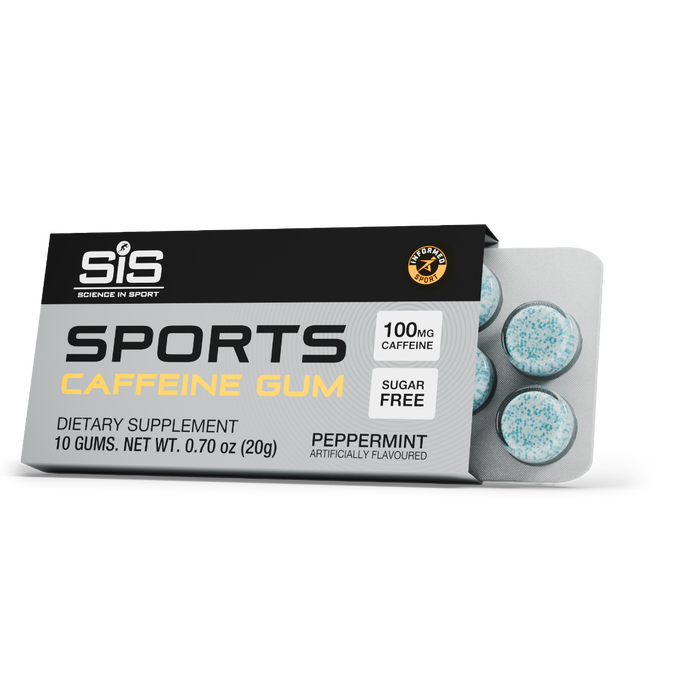
Caffeine is one of the most researched performance-support ingredients in sport. Traditionally consumed through coffee, capsules or energy drinks, it is now available in chewing gum—a portable format that may be especially practical for runners.
Research suggests that caffeinated gum can support certain aspects of endurance and high-intensity performance. However, the right product and dose depend on the athlete, distance, timing and complete formulation.
Here are nine science-based factors runners should consider.
1. Caffeine Can Support Running Performance
Caffeine primarily works by blocking adenosine receptors. This can reduce perceived tiredness and increase alertness during exercise.
The International Society of Sports Nutrition concluded that caffeine can enhance several aspects of athletic performance, including muscular endurance, movement velocity and aerobic endurance.[1] Benefits vary between individuals, and caffeine is not equally effective for every runner or event.
A 2024 study involving recreational runners found that 300 milligrams of caffeine delivered through gum improved average five-kilometre parkrun performance by approximately 17 seconds compared with placebo.[2] That study examined a specific dose and population; it does not mean every runner needs 300 milligrams.
2. The Gum Format May Affect Timing
Coffee and capsules are generally consumed well before exercise because caffeine must move through the gastrointestinal system. Gum provides a different delivery format.
During chewing, caffeine is released into saliva, and some may be absorbed through the lining of the mouth. A systematic review and meta-analysis reported that caffeinated gum was most consistently effective when consumed close to exercise, particularly within approximately 15 minutes of activity.[3]
Release speed still depends on the gum, caffeine amount and chewing protocol. Runners should not assume every product has an identical onset.
3. More Caffeine Is Not Always Better
Many sports studies have used caffeine doses based on body mass. Research commonly examines approximately 3–6 milligrams per kilogram, but some individuals may respond to less.[1]
For a 70-kilogram runner, 3 milligrams per kilogram equals 210 milligrams. That may be far more than a caffeine-sensitive person regularly consumes. Higher intake can increase the risk of nervousness, gastrointestinal discomfort, rapid heartbeat and disrupted sleep without providing additional performance benefits.
Runners should begin conservatively during training. Race day is not the time to experiment with a new stimulant or dosage.
4. Habitual Intake Can Influence the Experience
A runner who rarely consumes caffeine may respond differently from someone who drinks several coffees daily. Genetics, sleep, medications and habitual intake can all influence perceived effects.
Some studies of caffeinated gum have reported different outcomes among athletes with low and higher habitual caffeine consumption. The evidence on tolerance and performance remains mixed, but individual response clearly matters.
Keeping a training log can help runners compare dose, timing, pace, perceived exertion, sleep and side effects.
5. Gum May Be Easier on Some Runners’ Routines
A large coffee or canned energy drink can feel impractical before running. Consuming additional liquid may contribute to fullness, bathroom urgency or stomach discomfort in susceptible athletes.
Gum provides caffeine without requiring a full beverage. It is lightweight, easy to carry and potentially useful near the starting line or during longer events.
However, caffeine gum does not replace hydration or carbohydrate planning. Runners still need a fluid and fueling strategy appropriate for the event, weather and personal sweat rate.
6. The Supporting Ingredients Matter
Some energy gums deliver caffeine with a short list of ingredients. Others include compounds such as L-theanine, taurine, Alpha-GPC, B vitamins or botanical extracts.
L-theanine is commonly paired with caffeine. Controlled studies have reported that the combination may improve certain measures of attention and task performance.[4][5] These findings are relevant to cognitive performance, but they do not prove that L-theanine makes runners faster.
Alpha-GPC supplies choline involved in acetylcholine synthesis, while Rhodiola rosea has been studied in connection with fatigue and stress. Evidence varies considerably by ingredient, dose and population.
Runners comparing streamlined athletic gums with broader nootropic-style formulas can review this breakdown of caffeine gum for runners. The comparison illustrates how products may differ in purpose: one may prioritise a direct stimulant approach, while another may combine caffeine with cognitive-support ingredients.
7. Label Transparency Is Essential
A runner should be able to determine exactly how much caffeine is contained in each piece and serving. The label should also state:
- Recommended number of pieces
- Maximum daily serving
- Complete ingredient list
- Other stimulant sources
- Allergen information
- Safety warnings
The amounts matter more than the number of fashionable ingredients. A proprietary blend that hides individual quantities makes it harder to assess efficacy or safety.
Runners should calculate caffeine from all sources, including coffee, tea, gels, pre-workout supplements and gum. Accidentally stacking products can produce a much higher intake than intended.
8. Competitive Athletes Should Check Sport Rules
Under the World Anti-Doping Agency’s 2026 rules, caffeine is included in the Monitoring Program rather than the Prohibited List. That means caffeine itself is not currently banned, although WADA monitors patterns of use in competition.
Athletes remain responsible for every substance they consume. Multi-ingredient products may contain undeclared, contaminated or prohibited compounds.
Competitive runners should consider products tested by a credible third-party sport-certification programme. They should also confirm the current rules directly because anti-doping lists and policies can change annually.
9. Safety Must Come Before Performance
Caffeine can interfere with sleep, and poor sleep may undermine recovery more than a stimulant improves one workout. Late-afternoon or evening runners should consider how long caffeine remains active in the body.
Caffeine gum is not appropriate for everyone. Children, pregnant or breastfeeding individuals, people sensitive to caffeine, and those with certain cardiovascular conditions or medication interactions should seek appropriate professional guidance.
The gum itself must also be stored securely away from children and pets. Products containing xylitol are particularly dangerous to dogs.
The Bottom Line for Runners
Caffeinated gum offers a practical alternative to coffee, capsules and energy drinks. Research supports caffeine as an ergogenic aid, and studies specifically involving gum suggest potential benefits for endurance performance and perceived exertion.
The best choice depends on the runner’s goal. A minimal formula may appeal to an athlete seeking straightforward caffeine delivery. A broader formula containing L-theanine, Alpha-GPC or botanicals may appeal to someone interested in alertness and cognitive support beyond the run.
Neither approach is automatically superior. Finished products should be compared according to disclosed caffeine content, supporting ingredients, gum base, serving instructions, third-party testing and personal tolerance.
Test caffeine gum during ordinary training, begin with a conservative amount and avoid combining multiple stimulant products. When used responsibly, it may become a convenient part of a runner’s performance plan—but it cannot replace consistent training, sufficient sleep, appropriate nutrition or hydration.
References
- Guest NS et al. “International Society of Sports Nutrition Position Stand: Caffeine and Exercise Performance.” Journal of the International Society of Sports Nutrition, 2021.
- Whalley PJ et al. “Caffeine Gum Improves 5 km Running Performance in Recreational Runners.” European Journal of Sport Science, 2024.
- Barreto G et al. “Effects of Caffeine Chewing Gum Supplementation on Exercise Performance: A Systematic Review and Meta-Analysis.” European Journal of Sport Science, 2022.
- Owen GN et al. “The Combined Effects of L-Theanine and Caffeine on Cognitive Performance and Mood.” Nutritional Neuroscience, 2008.
- Giesbrecht T et al. “The Combination of L-Theanine and Caffeine Improves Cognitive Performance.” Nutritional Neuroscience, 2010.
- World Anti-Doping Agency. 2026 Monitoring Program, effective January 1, 2026.
This article is provided for general informational purposes and is not medical, nutritional or training advice.
