

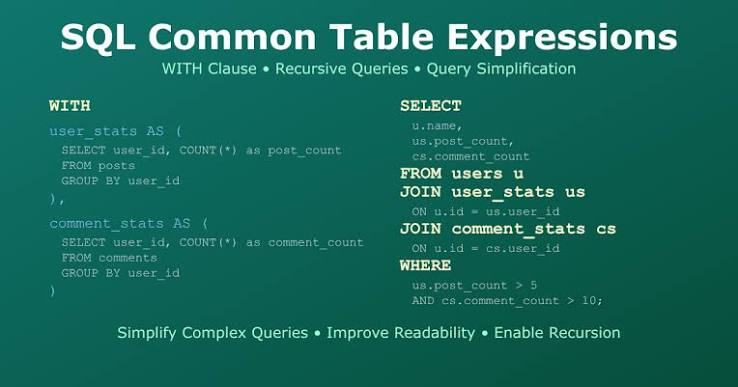
As datasets grow, SQL queries often become harder to read than they are to write. A single business question—like “Which customers are high value and recently active, and how do their returns compare to last month?”—can quickly turn into multiple joins, nested subqueries, and repeated filters. Common Table Expressions (CTEs) solve this problem by letting you build a query in logical steps. A CTE creates a temporary named result set that exists only for the duration of a single query. Instead of packing everything into one dense block, you can break the logic into smaller, clear components and then assemble them.
CTEs are widely used in analytics teams because they improve readability, reduce mistakes, and make complex transformations easier to review. That is why they are typically included early in a Data Analyst Course, alongside joins and aggregations, as a practical tool for producing maintainable SQL.
1) What a CTE Is and Why It’s Different From a Subquery
A CTE is written using the WITH keyword, followed by a name and a query that defines that name:
- You define a temporary result set (like a mini-table).
- You can reference it later in the main query, and sometimes across multiple parts of the query.
The key benefit is not that CTEs do something “new,” but that they make the logic structured. You can think of a CTE as a way to “label” a step in your analysis. That label acts like documentation inside the SQL itself.
CTEs are particularly helpful when:
- You would otherwise repeat the same subquery multiple times.
- You need multiple transformation stages (filter → aggregate → join → final calculation).
- You want to make a query easier for another analyst to audit or modify.
In real reporting environments, the cost of misunderstandings is high. An unreadable query increases the chance of joining at the wrong level, filtering incorrectly, or duplicating rows. CTEs reduce that risk by making each step explicit—an expectation in teams trained through a Data Analyst Course in Hyderabad, where SQL is often used for production reporting and dashboard pipelines.
2) A Practical Example: Building a “High-Value Customers” View Step-by-Step
Consider an e-commerce business wanting to identify high-value customers based on monthly spend and recent activity. Without CTEs, this can become a long nested query. With CTEs, it becomes a sequence of clear steps:
- Step 1: Identify orders in the last 90 days
- Step 2: Summarise customer spend and order count
- Step 3: Filter customers above a threshold
- Step 4: Join customer attributes and produce the final output
A key advantage is that each step can be validated independently. For example, you can run the “orders_last_90_days” CTE alone to confirm date filters are correct, then run the “customer_summary” step to check row counts and totals.
This staged approach is not just clean; it is safer. In analytics, safety often means preventing silent errors—like inflated sums due to one-to-many joins. CTEs encourage you to aggregate at the right grain before joining, which reduces common reporting issues.
3) Using CTEs for Trend Reporting and Operational Metrics
CTEs are especially effective for time-based reporting, which often requires intermediate calculations.
Example use case: Month-to-date vs last month-to-date
To compute fair comparisons, analysts usually need:
- a date range for current MTD,
- a matching date range for the prior month,
- daily totals,
- then a final comparison.
With CTEs, these become readable blocks: one CTE defines date windows, another computes daily revenue, another aggregates totals, and the final query calculates variance. This avoids repeating date logic across multiple places, which is one of the biggest sources of reporting inconsistencies.
Example use case: Funnel analysis
For funnels (visits → sign-ups → activations), each stage may live in a different table. A CTE per stage makes it clear what qualifies as a “sign-up” and what counts as “activation,” rather than hiding definitions inside nested clauses.
This structured thinking is precisely why CTEs are emphasised in a Data Analyst Course—they help analysts write SQL that scales across multiple reporting needs, not just one-off queries.
4) Best Practices and Common Mistakes With CTEs
CTEs make SQL cleaner, but only if you use them with discipline.
Best practices
- Name CTEs clearly: Use names like orders_last_30_days or customer_monthly_spend. Avoid vague labels like temp1.
- Keep each CTE focused: One purpose per CTE—filtering, aggregation, or enrichment—not all at once.
- Validate row counts: If a CTE represents customers, make sure it stays at customer level. If it represents orders, ensure it stays at order level.
- Avoid unnecessary CTE chains: If a step does not add clarity, do not add it just to increase structure.
Common mistakes
- Forgetting CTEs are temporary: They exist only inside that query. If you need reuse across multiple reports, a view or a table may be better.
- CTE bloat: Too many small CTEs can make queries longer without improving understanding. Aim for “few, meaningful steps.”
- Performance assumptions: Some databases optimise CTEs well; others may treat them less efficiently depending on the engine and query design. The main purpose should be clarity, while still monitoring performance for very large datasets.
In production analytics, readability and correctness are often more valuable than cleverness. Clear SQL is easier to peer review, easier to maintain, and easier to debug. That mindset is increasingly expected in teams and is often reinforced through a Data Analytics Course in Hyderabad, where learners are trained to write SQL that others can trust.
Conclusion
Common Table Expressions are a practical way to simplify complex SQL by turning a single complicated query into a sequence of named, understandable steps. They make logic easier to review, reduce duplication, and help analysts avoid common errors related to joins, grain mismatch, and repeated filters. When used well, CTEs become a style of thinking: define the problem in stages, validate each stage, then combine them into a final answer. For anyone building strong SQL fundamentals through a Data Analyst Course or a Data Analytics Course in Hyderabad, CTEs are not an “advanced trick”—they are a reliable method for writing clean, accurate, and maintainable analytics queries.
Name:Data Science, Data Analyst and Business Analyst Course in Hyderabad
Address: 8th Floor, Quadrant-2, Cyber Towers, Phase 2, HITEC City, Hyderabad, Telangana 500081
email:[email protected]
Phone number: 095132 58911
