

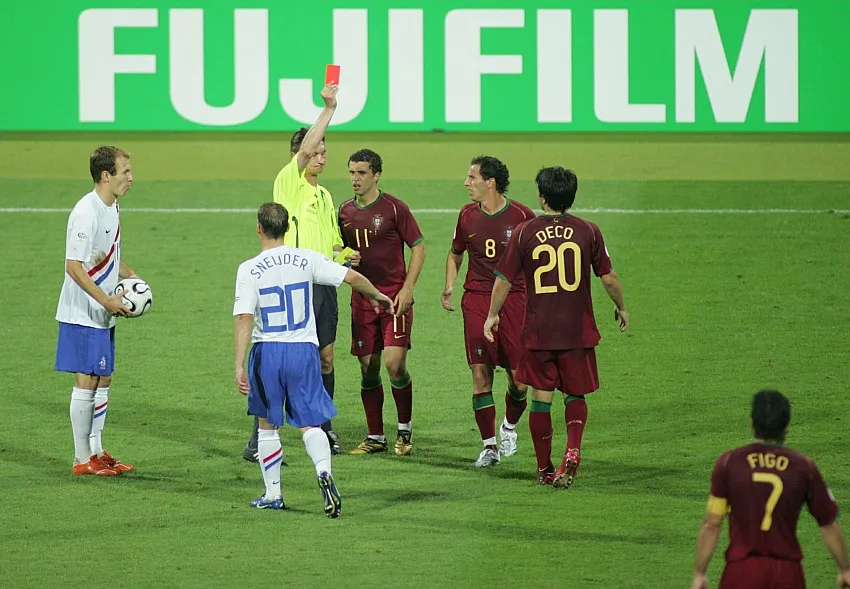
When you think of a World Cup game overflowing with red cards, you are almost certainly picturing Portugal vs Netherlands in the 2006 round of 16, the match later dubbed the “Battle of Nuremberg.” In Nuremberg’s Frankenstadion, Russian referee Valentin Ivanov showed 16 yellow cards and 4 reds—two for each team—setting a World Cup record for disciplinary sanctions in a single match as Portugal won 1–0. Watching the full 90 minutes with a tactical eye reveals how structure, pressing, and game-state pressure made that outcome more likely than the “pure chaos” label suggests.
Why This Match Holds the World Cup Red-Card Record
The Portugal–Netherlands clash in Germany is officially the World Cup match with the most red cards ever issued. Across 90 minutes plus stoppage time, Ivanov produced four reds and 16 yellows, meaning that almost every significant duel or break in play seemed to carry the risk of another sanction. Portugal’s Costinha and Deco, and the Netherlands’ Khalid Boulahrouz and Giovanni van Bronckhorst, were all sent off, leaving both teams to finish with nine players.
The record becomes even more striking when you consider the context. This was a round-of-16 tie between two technically strong sides, not a mismatched qualifier or lower-division grudge match, and the winner’s reward was a quarter-final against England. For live viewers, the constant card-flashing turned what could have been a standard tactical contest into a game where every minor foul felt like it might tip the entire tie.
The Base Shapes: Compact Midfields and Aggressive Duels
From the start, both teams set up in ways that condensed the game into central zones, increasing the volume of collisions and contested second balls. Portugal’s structure under Luiz Felipe Scolari used a compact midfield behind Pauleta, with Cristiano Ronaldo and Luís Figo given licence to drive inside rather than stay wide. Marco van Basten’s Netherlands, meanwhile, used a shape that kept creative players like Wesley Sneijder and Arjen Robben finding pockets between the lines while relying on defenders such as Boulahrouz to step out aggressively into duels.
For viewers, this meant the ball spent much of its time in crowded central spaces where tackles arrived fractionally late and players frequently challenged from blind angles. The more both teams compressed their lines to deny room for Ronaldo’s runs or Robben’s dribbles, the more likely it became that contact would escalate into bookings as the referee tried to keep a lid on repeated tactical fouls and holding.
The First Goal and How Game State Pushed Physicality Up
The only goal of the game came in the 23rd minute, when Maniche finished from inside the box after being set up by Pauleta. That strike put Portugal 1–0 up and quietly rewrote how both teams approached risk. With a lead to protect, Portugal leaned into time management, tactical fouling, and physical contests in midfield to break up Dutch rhythm; the Netherlands, chasing the game, pressed more aggressively and drove forward with more direct running.
As you watched, you could see the Dutch defenders stepping higher and earlier to challenge Portuguese forwards, while Portuguese midfielders and full-backs intensified their contact to disrupt build-up. In a match where the referee had already shown willingness to book players, this combination—one team managing a narrow lead and the other pushing harder into contact—set the stage for repeated yellow cards and, eventually, dismissals.
How the Card Count Snowballed: Thresholds, Retaliation, and Referee Rhythm ดูบอลสด
Once a few early yellows had been shown, the match entered a feedback loop where players, referee, and game state all pushed the card count higher. With multiple players “on a card,” every subsequent foul carried more risk, yet the intensity of the duels did not drop—in part because both sides felt wronged at different moments, and in part because the stakes of a World Cup knockout do not encourage backing off. When you ดูบอลสด contests like this, you can often sense the tipping point: a hard tackle not punished as the players expect, a retaliation, and then a spell where the referee responds by brandishing cards in quick succession to regain control.
In Nuremberg, Ronaldo’s injury from a heavy Boulahrouz challenge, multiple confrontations after tackles, and visible dissent fed into that rhythm. Each new incident felt like a rerun of the last, but with higher emotional stakes because another player risked suspension or dismissal. For live viewers, the match became less about whether the Netherlands could find an equaliser and more about whether either team would finish with enough players to control any late surge.
How Red Cards Reshape Tactics and Chance Creation
Every dismissal altered the tactical map and the way the match looked on screen. Portugal losing Costinha in first-half stoppage time forced them to adjust their midfield coverage and spend longer phases without the ball, making their transitions more sporadic and their defensive line more exposed to Dutch pressure. When Boulahrouz saw red in the second half, the Netherlands had to rebalance their back line and rely even more on individual attacking actions from Robben and company rather than stable possession.
As further reds reduced both sides to nine, the field paradoxically opened up in some channels while becoming even more cramped centrally, because remaining players tried to protect the most dangerous zones near their own box. For viewers, this created a strange visual: space available for switches and long diagonals, but fewer structured attacks as tired, emotionally charged players reacted moment to moment rather than executing coherent patterns. The net effect was more broken play, more last-ditch tackles, and further opportunities for cards.
A Live-Match Checklist for Spotting Games Prone to Red-Card Spikes
Matches like the “Battle of Nuremberg” are extreme, but they share traits with other high-card contests. When you watch live, a few simple checks can help you anticipate when a game might be heading toward multiple reds rather than a single isolated dismissal.
- Early booking density: Track how many yellows appear in the first 25–30 minutes and whether they cluster in the same zones or among key duelists.
- Role overlap: Note if primary ball-winners, man-markers, or “enforcers” pick up early cards; if they stay on, their usual role almost guarantees further risky challenges.
- Game-state pressure: Observe how a narrow lead or an elimination scenario pushes the trailing side to force more duels, and the leading side to foul more tactically.
- Referee threshold: Watch whether the referee keeps the same standard across incidents; inconsistency often fuels retaliation and dissent, which increase the card count.
- Substitution choices: Notice if coaches leave multiple booked players on because they are tactically vital; the longer they stay, the higher the chance of a second caution or flashpoint.
Applied retrospectively to Portugal–Netherlands 2006, this checklist would have flashed red early: high booking density, key midfielders and defenders cautioned, tight game state after 1–0, and a refereeing performance that escalated rather than defused the confrontation. Using the same lens in future tournaments helps you read when a match is drifting toward a disciplinary explosion rather than being surprised by a sudden flurry of reds.
Portugal vs Netherlands 2006 in the Context of Record Red-Card Games
At the World Cup level, no other match has matched Portugal vs Netherlands for combined red cards. At a broader global level, however, the Guinness World Record for most red cards in a single match belongs to a 2011 Argentine Primera D game between Claypole and Victoriano Arenas, where 36 people—including all players, substitutes, and staff—were reportedly sent off.
From a viewing standpoint, the World Cup record carries more tactical interest because of the quality and stakes involved. In Nuremberg, you saw elite players adapting (or failing to adapt) to a game where each duel risked suspension, and coaches trying to balance stability with the need to chase the result. Comparing that to lower-division chaos helps underline how different contexts—elite tournament vs local rivalry—shape both the kind of fouls committed and the viewer’s focus when the card count climbs.
Key Phases of the “Battle of Nuremberg” at a Glance
| Match Phase | Scoreline in Phase | Cards Issued and Key Dismissals Seen Live | Tactical Pattern Viewers Could Observe |
| Opening half-hour (0–30’) | Portugal lead 1–0 | Early yellows to multiple players; Costinha booked; physical duels increase | Compact shapes, many central clashes, Portugal happy to break up Dutch rhythm |
| Late first half | Still 1–0 | Further bookings; Costinha sent off for second yellow near half-time | Portugal drop deeper, prioritise disruption; Netherlands push forward more |
| Mid second half (60’–75’) | 1–0 Portugal | Boulahrouz dismissed; yellow count continues to grow | Dutch reshape defence, still chase equaliser; more space appears in wide areas |
| Chaotic closing stretch (75’–90+’) | Ends 1–0; both sides on 9 men | Deco and van Bronckhorst sent off; total of 4 reds and 16 yellows | Broken play, constant stoppages, long clearances and desperate tackles define the final minutes |
This kind of phase-based view lets you connect disciplinary spikes to tactical and emotional shifts instead of treating the card tally as a separate story.
Summary
Portugal vs Netherlands in the 2006 World Cup round of 16 earned its “Battle of Nuremberg” label and the record for most red cards in a World Cup match because compact shapes, a tight 1–0 game state, and escalating duels collided with a strict, increasingly reactive refereeing performance. Four red cards and sixteen yellows were not random; they were the visible outcome of a match where neither side adjusted their physicality to the referee’s standard and where protecting or chasing a narrow lead pushed players into repeated high-risk challenges. For modern viewers, using this game as a template—watching booking density, key roles on cards, and game-state pressure—offers a clearer way to understand when a match is sliding toward a historic disciplinary tally and how that shapes the เว็บดูบอล changy you see.
