

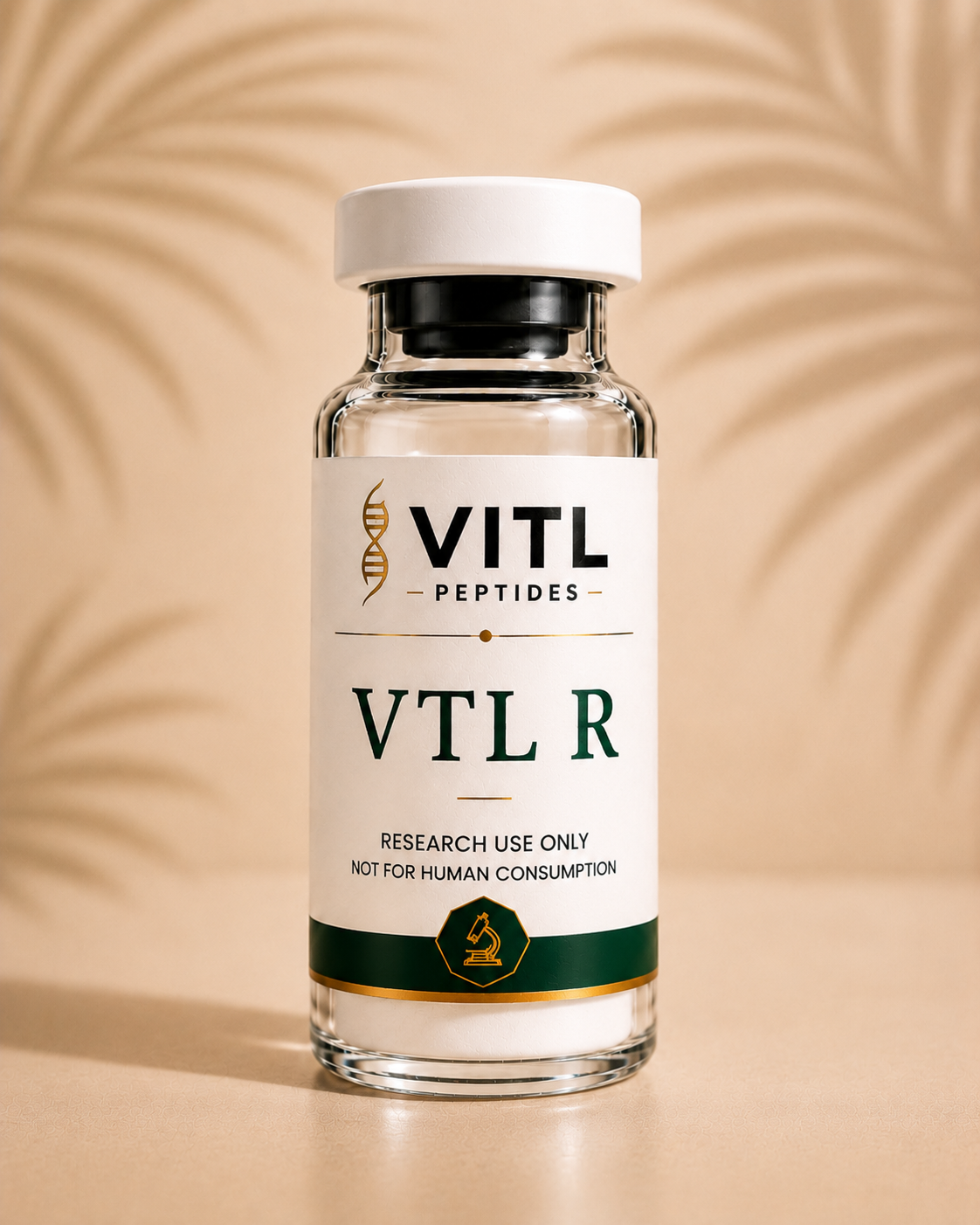
Laboratory research involving metabolic signaling and receptor pharmacology depends on clearly identified research materials and reliable analytical documentation. Researchers evaluating a compound need more than a product name or a stated purity percentage. They must be able to review its formulation, available specifications, batch identification, and supporting laboratory records. These details help establish whether the supplied material is adequately documented for a defined research workflow. They also make it easier to distinguish a supplier’s product description from information verified through analytical testing.
Research grade VTL-R is listed as a lyophilized research compound associated with multi-receptor signaling and metabolic pathway investigations. Its product information identifies receptor pharmacology, cellular energy regulation, and related biochemical processes as areas of laboratory research interest. The listing also provides product specifications and batch-specific analytical documentation for applicable lots. Researchers evaluating this material should review the available records rather than relying on broad descriptions alone. A careful assessment begins with product identity, formulation, and the scope of the supporting Certificate of Analysis (COA).
What Is VTL-R in a Laboratory Research Context?
VTL-R is described in the product documentation as a multi-receptor research compound intended for controlled laboratory investigation. The stated research areas include receptor pharmacology, metabolic pathway interactions, and cellular energy regulation. These descriptions establish the broad scientific context in which the material is presented, but they do not replace a detailed molecular characterization. Researchers should avoid assuming that a product name alone identifies its complete structure, sequence, or receptor activity. Those properties require appropriate technical documentation and experimental evidence.
Multi-receptor signaling is a broad area of molecular and cellular research. It concerns the interactions between signaling molecules, receptors, and downstream pathways that influence cellular responses. Investigations may examine receptor activity, pathway interactions, changes in cellular signaling, and relationships between different biochemical processes. The design of each experiment determines which mechanisms are being evaluated and what conclusions the resulting data can support. A supplier’s description of a compound’s research relevance should therefore be treated as context, not as proof of a particular biological outcome.
For VTL-R, the product page identifies the following areas of research interest:
- Multi-receptor signaling: Experimental investigation of interactions involving more than one receptor pathway.
- Receptor pharmacology: Laboratory study of receptor-related mechanisms and signaling responses.
- Metabolic pathway interactions: Examination of biochemical processes associated with cellular metabolism.
- Cellular energy regulation: Research into pathways involved in cellular energy-related processes.
- Biochemical signaling: Investigation of molecular interactions that contribute to cellular responses.
These areas can involve different experimental models, analytical methods, and research questions. The product description does not provide a complete receptor map or a detailed molecular mechanism. Researchers should consult appropriate primary scientific literature and technical product documentation before assigning specific activity to the material. This distinction is essential for accurate reporting and reproducible research.
VTL-R Product Specifications and Lyophilized Formulation
The VTL-R product listing identifies the supplied material as a lyophilized powder for research use only. Lyophilization is a freeze-drying process used to remove water from a material under controlled conditions. The resulting dry formulation is commonly used for laboratory materials where a defined solid presentation is required. However, the presence of a lyophilized format does not independently establish stability, purity, or suitability for a particular experimental protocol. Those considerations depend on the material’s specifications, storage requirements, and supporting documentation.
The product page lists multiple selectable strengths and identifies the material as a 30mg product in its displayed specification section. Researchers should verify the selected product variant and its corresponding documentation when reviewing an order. Different strengths or catalog variants should not be assumed to share identical batch records. Product identification should remain consistent across the label, order record, and COA. This helps reduce ambiguity when materials are received, logged, and referenced in laboratory records.
The main product details to verify include:
- Product identity: Confirm that the label and order record identify VTL-R correctly.
- Formulation: Check that the supplied material is described as lyophilized powder.
- Selected strength: Verify the exact catalog variant and stated quantity.
- Batch identification: Match the lot or batch number to the applicable analytical documents.
- Research-use designation: Confirm the stated restrictions and intended laboratory context.
- Storage information: Review the product documentation for relevant storage and handling requirements.
These checks are useful during procurement and material intake. They also help researchers maintain consistent records when several compounds or product variants are present in the same facility. A clearly documented product should be identifiable without relying on packaging appearance or informal descriptions. Any discrepancy between the label, order details, and laboratory records should be resolved before the material is incorporated into a research inventory.
Understanding Multi-Receptor Signaling and Metabolic Research
Receptor pharmacology examines how molecules interact with receptors and how those interactions relate to cellular signaling. Researchers may investigate receptor binding, activation, inhibition, downstream messenger activity, or interactions between different pathways. Multi-receptor research adds another layer because experimental outcomes may involve more than one signaling system. The relationships between these pathways can be complex and dependent on the experimental model. As a result, conclusions should be limited to what the selected methods and evidence actually demonstrate.
Metabolic signaling research examines the biochemical processes involved in how cells regulate and use energy. These processes involve networks of enzymes, receptors, signaling molecules, and intracellular pathways. Researchers may study how different signals interact, how cells respond to changing conditions, or how pathway activity varies between experimental models. A compound described as relevant to metabolic signaling may be considered within this broad research area, but that description does not establish a specific metabolic effect. Detailed conclusions require controlled experiments and appropriately validated analytical methods.
When evaluating VTL-R for a research program, the scientific question should guide the assessment. Researchers should first identify the pathway or receptor mechanism under investigation, then determine whether the available technical information supports studying the material in that context. A product description can help establish initial relevance, but it cannot answer every question about molecular identity or experimental behavior. The absence of detailed sequence or receptor information should be treated as an information gap rather than filled with assumptions. This approach supports more precise study design and interpretation.
Why Batch-Specific COAs Matter
A Certificate of Analysis provides analytical information about a particular product sample or batch. For research materials, a COA can help establish what was tested, which methods were used, and what results were reported. VITL Peptides provides batch-specific documentation for applicable VTL-R lots, with the product page identifying purity, identity, endotoxin, and other available analytical specifications as areas covered by its records. The displayed listing reports 99%+ purity with HPLC verification. Researchers should consult the actual report for the selected batch to understand the result and its limitations.
A purity percentage is useful, but it is only one part of material characterization. It does not independently confirm every aspect of identity, composition, or suitability for a particular experiment. The analytical method, reference standards, sample identification, and reporting details all affect how results should be interpreted. Researchers should also distinguish a product-level statement from a result tied to a specific lot. The batch number on the COA should correspond to the material being evaluated.
A useful COA review should cover:
- Batch or lot number: Confirm that the report matches the supplied material.
- Identity testing: Review whether the report includes an identity result and how it was established.
- Purity result: Check the reported value and the analytical method used.
- HPLC documentation: Review the chromatographic information provided and the scope of the reported result.
- Endotoxin testing: Check whether an endotoxin report is available and what it covers.
- Report details: Identify the laboratory, testing date, sample information, and any stated limitations.
HPLC, or high-performance liquid chromatography, is an analytical technique used to separate and assess components in a sample. It can provide information relevant to purity analysis, depending on the method and reference materials used. It should not automatically be treated as a complete confirmation of molecular identity. Additional analytical methods may be necessary to answer specific characterization questions. Researchers should interpret each reported test according to its stated purpose and technical scope.
Comparing Research Materials and Documentation Standards
Researchers often evaluate several compounds within a broader laboratory program. The comparison should focus on the scientific question, material identity, formulation, and available analytical evidence rather than assuming that products with similar packaging or purity claims are interchangeable. For example, lyophilized TB-500 is presented in a different research context, with its product information referring to cellular migration and cytoskeletal pathway investigations. Its stated research areas and documentation should be assessed independently of VTL-R.
Similarly, lyophilized SS-31 is described in relation to mitochondrial biology, cellular bioenergetics, and oxidative pathway research. These areas differ from the multi-receptor and metabolic signaling context presented for VTL-R. Comparing the products does not establish that they share a mechanism or can be substituted in an experimental design. Each material requires its own identity checks, analytical review, and literature assessment. This is particularly important when a research project involves several compounds with different molecular characteristics.
A consistent supplier evaluation process can make these comparisons more reliable. Researchers should look for clearly identified variants, accessible batch records, and product descriptions that distinguish documented specifications from broader research context. They should also assess whether the supplier provides enough information to resolve questions about a particular lot. Product pages that connect material details with supporting records make the initial review more straightforward. Final decisions should still be based on the requirements of the research institution and the scientific protocol.
Storage, Handling and Laboratory Recordkeeping
Lyophilized research materials require storage and handling consistent with their product documentation. The VTL-R listing advises protecting the material from light, moisture, and temperature excursions. It also directs researchers to follow the applicable COA, product documentation, and institutional standard operating procedures. These instructions should be treated as product-specific requirements rather than replaced with generalized storage assumptions. The appropriate laboratory personnel should review the current documentation before accepting or handling the material.
Recordkeeping is equally important. Laboratories should maintain a traceable record of product identity, supplier, batch number, receipt date, and associated analytical documents. Any storage or handling requirements should be documented according to institutional procedures. If a discrepancy or damaged shipment is identified, it should be recorded and referred through the supplier’s established support process. These practices help preserve traceability and make it easier to review the origin of materials used in a research project.
Evaluating Supplier Transparency
A research-material supplier should make it possible for qualified buyers to understand what is being purchased and which records support the listing. Useful information includes product specifications, batch identification, available COAs, analytical testing details, and clear research-use restrictions. Researchers should also be able to distinguish current batch documentation from general statements about quality. A supplier’s transparency is demonstrated through accessible records and clear responses to technical or order-related questions, not only through promotional claims.
VITL Peptides presents VTL-R as a lyophilized research material and provides batch-specific analytical documentation for applicable lots. Researchers evaluating the listing should confirm that the selected variant and its corresponding COA meet their institution’s procurement and documentation requirements. Any questions about product identification, available reports, or order records can be directed to the supplier’s contact VITL Peptides support desk. Keeping those questions tied to the exact product and batch helps avoid ambiguity. Supplier communication should complement, not replace, independent scientific assessment.
Conclusion
Research-grade VTL-R is presented as a lyophilized compound for laboratory investigations involving multi-receptor signaling, receptor pharmacology, and metabolic pathway interactions. A thorough product evaluation should consider its exact variant, formulation, batch identification, and available analytical records. COAs provide useful information about reported purity and other tested specifications, but each result must be interpreted within the scope of its method. Clear storage guidance, traceable records, and supplier transparency further support responsible research procurement. The final decision should reflect the scientific requirements and institutional standards of the laboratory.
Frequently Asked Questions
1. What is research-grade VTL-R?
VTL-R is listed as a lyophilized research compound associated with multi-receptor signaling, receptor pharmacology, and metabolic pathway investigations. Its product documentation describes it as intended for controlled laboratory research only, not for human or veterinary consumption.
2. What form is VTL-R supplied in?
The product page identifies VTL-R as a lyophilized powder. Researchers should verify the selected product variant, stated strength, and corresponding batch documentation before accepting the material into a laboratory inventory.
3. What does the VTL-R COA confirm?
The applicable Certificate of Analysis provides batch-specific analytical information. The product listing identifies purity, identity, endotoxin, and other available specifications as areas covered by its documentation. Researchers should review the actual report to understand which tests were performed and what the results establish.
4. Why is HPLC testing relevant to VTL-R?
High-performance liquid chromatography is an analytical method used to separate and assess components in a sample. It can support purity analysis, but its results should be interpreted according to the method and report. HPLC verification alone should not be treated as confirmation of every aspect of molecular identity.
5. Is VTL-R intended for human or veterinary use?
No. VTL-R is labeled for research use only. The product is not intended for human or veterinary consumption or administration, or for diagnostic, therapeutic, or clinical use.
